What Do Your Appliances Cost to Run?
Any appliance's running cost comes from one short formula and two numbers you already have. Here is the sum, worked examples, and what standby really costs.
In this article
Why the bill is hard to read
Your electricity bill is one number, which tells you nothing about where the money goes. Electricity is sold by the kilowatt-hour (kWh): 1,000 watts used for one hour. Appliances are labelled in watts, and you use them for minutes or hours. Nobody does that conversion in their head, so the heater that costs a lot and the lamp that costs almost nothing look the same on the bill.
The formula
Cost = watts × hours used ÷ 1,000 × your price per kWh
In words: multiply the watts by the hours, divide by 1,000 to get kWh, then multiply by your rate.
Example: a 1,500-watt heater running for 4 hours uses 6 kWh. Multiply 6 by the rate on your bill to get the cost of that evening.
The electricity cost calculator does this for any appliance and shows the weekly, monthly and yearly cost.
Find your two numbers
The wattage is on a label on the back or underside of the appliance, or in the manual. If the label shows amps, multiply by your voltage (120 in the US, 230 in the UK) to get watts.
Your rate is on your bill, shown as cents or pence per kWh. Use your own figure if you can; the examples below use national reference rates.
In the United States, the examples use 18.2 cents per kWh, the US Energy Information Administration's forecast average residential price for 2026. State averages vary widely.
In the UK, the examples use 26.32 pence per kWh, the electricity unit rate reported for Ofgem's price cap from 1 October to 31 December 2026. The cap changes every three months, and your region and tariff may differ.
Worked examples
The wattages here are typical figures for illustration. Check the label on your own appliance.
| Appliance and use | Energy per year |
|---|---|
| LED bulb, 10 W, 5 hours a day | 18 kWh |
| Device on standby, 10 W, all day | 88 kWh |
| Kettle, about 0.25 kWh a day | 91 kWh |
| TV, 100 W, 4 hours a day | 146 kWh |
| Air purifier, 30 W, all day | 263 kWh |
| Space heater, 1,500 W, 4 hours a day for 120 days | 720 kWh |
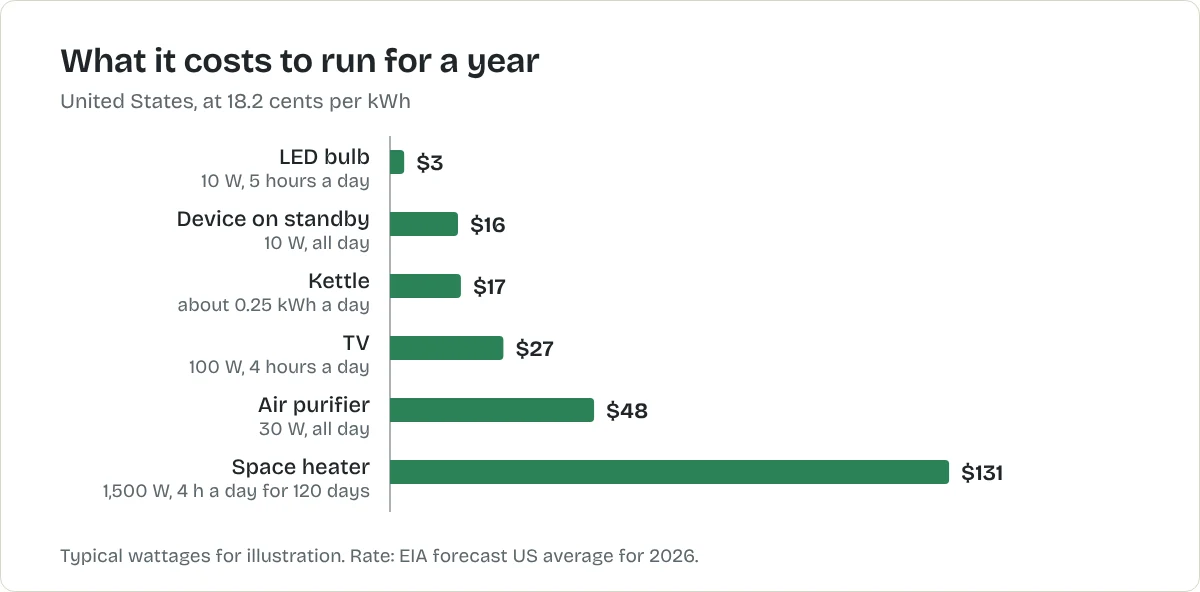
In the United States, at 18.2 cents per kWh, that works out as follows.
In the UK, at 26.32 pence per kWh, that works out as follows.
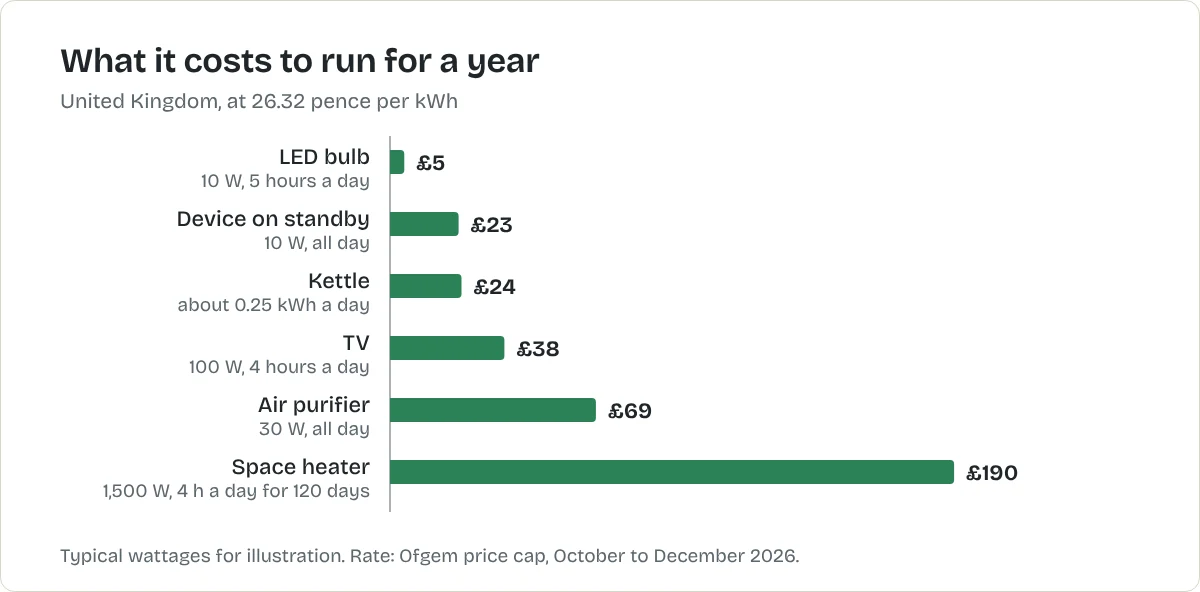
Two things stand out. Heat is expensive: the heater costs more than everything else in the table combined. And anything that runs all day adds up, even at low wattage.
What standby really costs
Standby power is the trickle that devices draw while "off". Each one is small. Together they run all day, every day.
A UK study of 250 homes behind the Energy Saving Trust's standby figure measured an average of about 23 watts of continuous standby use per household. Over a year, 23 watts is about 201 kWh. Multiply that by your rate to see what it means for you.
Be realistic about the saving. You cannot switch off the router or the fridge, and modern TVs draw very little in standby. Set-top boxes, games consoles and older audio equipment are the usual culprits. Expect to save part of that figure, not all of it.
What to do first, for free
- Find the heaters. Anything that makes heat costs the most: space heaters, tumble dryers, ovens, kettles and immersion heaters. Use them less or for shorter times before worrying about anything else.
- Boil only the water you need.
- Switch the TV corner off at the wall overnight if the socket is easy to reach.
- Check your tariff. A cheaper rate cuts the cost of everything at once.
For the wider plan, see how to reduce electricity bills in an apartment.
Measure it instead of guessing
A label shows the maximum draw. Many appliances cycle on and off, so the label overstates what they use. A plug-in energy monitor sits between the socket and the appliance and shows the real consumption over a day or a week. A smart plug with energy monitoring does the same job and can also switch the appliance off on a schedule; see smart plugs for beginners.
Products that can help
Best for finding out what one appliance really uses
Plug-in electricity usage monitor
A meter that sits between the socket and an appliance and shows its consumption. This is a type of product, not one model. The button opens the retailer's results for it, so compare a few before you choose.
What we like
- Measures real use over a day or week, not the label's maximum
- No app or Wi-Fi needed
- Moves from appliance to appliance
What to know
- Buy the version made for your country's sockets and voltage
- Small displays are hard to read behind furniture
- Accurate enough to compare appliances, not to check a bill
United States
United Kingdom
Not listed with our CA retailers yet.
Not listed with our AU retailers yet.
Research-based recommendation: we have not tested this product ourselves. How we evaluate products. Details checked October 2026.
Best for switching the TV corner off at night
Surge-protected power strip with individual switches
An extension lead with a switch for each outlet, so standby devices can be cut off without unplugging. This is a type of product, not one model. The button opens the retailer's results for it, so compare a few before you choose.
What we like
- One reachable place to switch several devices off
- Keep the router on while the TV and console go off
- Surge protection for electronics
What to know
- Never plug one strip into another
- Check the strip's total load rating; heaters belong in a wall socket
- Some set-top boxes take a while to restart after a full power-off
United States
United Kingdom
Not listed with our CA retailers yet.
Not listed with our AU retailers yet.
Research-based recommendation: we have not tested this product ourselves. How we evaluate products. Details checked October 2026.
Where the easy savings are
- Lighting. If you still have old bulbs, LEDs give the same light for far less power. See how to brighten a dark apartment without rewiring.
- Always-on appliances. Size them correctly so they can run on a low setting. How to improve air quality in a small apartment shows how to size an air purifier.
- Heating one room. Heat the person before the room: an extra layer or a blanket costs nothing to run.
Frequently asked questions
How do I calculate the cost of running an appliance?
Multiply its wattage by the hours you use it, divide by 1,000 to get kWh, then multiply by your electricity rate per kWh.
Which appliances use the most electricity?
Anything that produces heat: space heaters, tumble dryers, ovens, electric showers and kettles. Electronics and LED lighting use far less.
Does unplugging things save money?
A little. Standby power is small per device but runs all day. Focus on set-top boxes, consoles and older equipment, and do not expect it to transform your bill.
Are energy monitor plugs accurate?
They are accurate enough to compare appliances and spot the expensive ones. For billing, your meter is the reference.
What is a kWh?
A kilowatt-hour is 1,000 watts used for one hour. It is the unit your electricity supplier charges for.
Sources
Related articles
Energy & Money Saving
How Much Does a Space Heater Cost to Run?
A typical space heater costs far more per hour than a heated throw or electric blanket. Here is the sum at current US and UK rates, and how to run one safely and cheaply.
Energy & Money Saving
What Uses the Most Electricity at Home?
Heating and cooling come first in most homes, then water heating, then the fridge and lighting. Here is how to find out what uses the most in yours, US and UK.
Energy & Money Saving
Electric Blanket vs Space Heater: Cost Compared
Heating yourself costs a fraction of heating a room. How the running costs of an electric blanket, a heated throw and a space heater compare at US and UK rates.