How to Brighten a Dark Apartment Without Rewiring
Most dark rentals are short of light sources, not windows. Start with five free fixes, then add brighter bulbs, plug-in wall lights and stick-on lights. No electrician needed.
In this article
Why your apartment feels dark
A dark apartment is rarely short of windows alone. It is usually short of light sources. Three things cause most of the gloom:
- One overhead light per room, or none. A single ceiling fitting leaves the corners in shadow and flattens the room.
- Surfaces that soak up light. Dark floors, sofas and curtains absorb light instead of bouncing it back.
- Blocked daylight. Furniture and heavy window coverings often cover the little daylight you have.
Fix those three and the room changes, often before you buy a lamp. None of it needs an electrician or your landlord's permission.
What to try first, for free
- Clear the window. Move tall furniture away from it and pull curtains fully past the frame so no glass is covered.
- Clean the glass, inside and, if you can reach safely, outside.
- Put a mirror opposite or beside the window. It sends daylight deeper into the room.
- Move a lamp you already own into the darkest corner. Light bouncing off two walls looks brighter than the same lamp in the middle of a room.
- Check the bulbs. A dim bulb in a good lamp is the most common problem, and the cheapest to fix.
Read the bulb box: lumens and Kelvin
Watts tell you how much power a bulb uses. Lumens tell you how bright it is. ENERGY STAR's chart puts a 60-watt-equivalent bulb at about 800 lumens and a 100-watt-equivalent at about 1,600. If your main lamp has an 800-lumen bulb, swapping to 1,600 doubles its output.
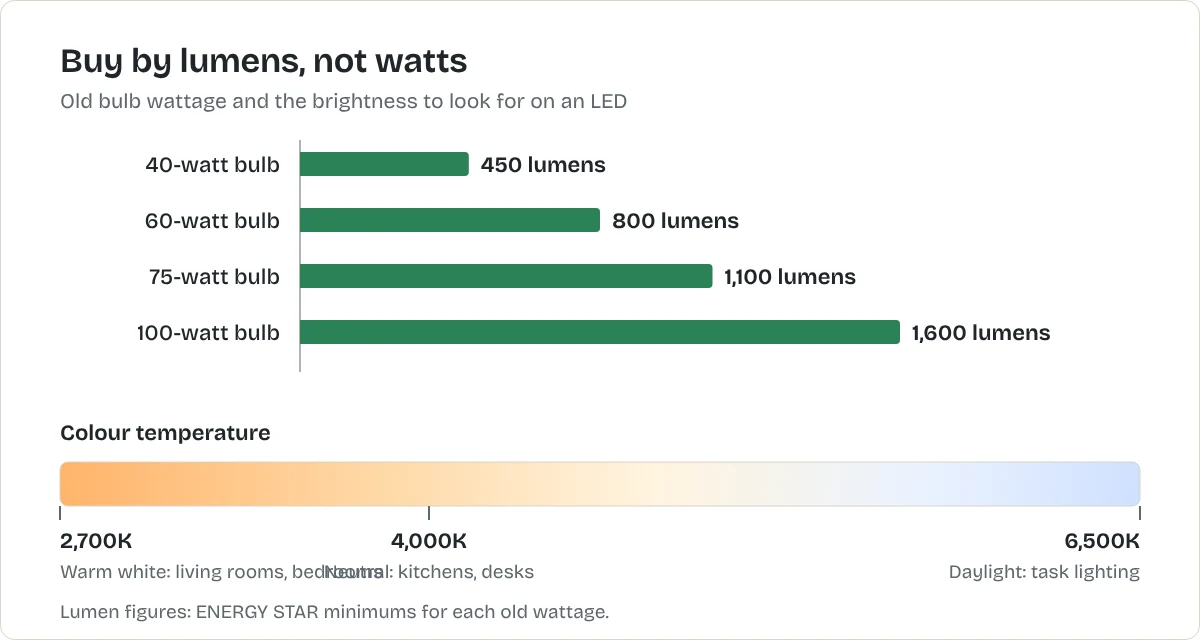
Colour matters as much as brightness. It is measured in Kelvin (K). Lower numbers look warm and yellowish; higher numbers look cool and bluish.
- 2,700K to 3,000K suits living rooms and bedrooms.
- Around 4,000K suits kitchens and desks.
- 5,000K and above looks like daylight. It helps a work corner but can feel harsh at night.
Before you buy, check the lamp's maximum wattage label. An LED that gives 1,600 lumens uses far less power than an old 100-watt bulb, so it is within the limit of most lamps.
Layer your light at three heights
A room looks bright when light comes from several places. Aim for three sources in a living room: one high, one at eye level, one low.
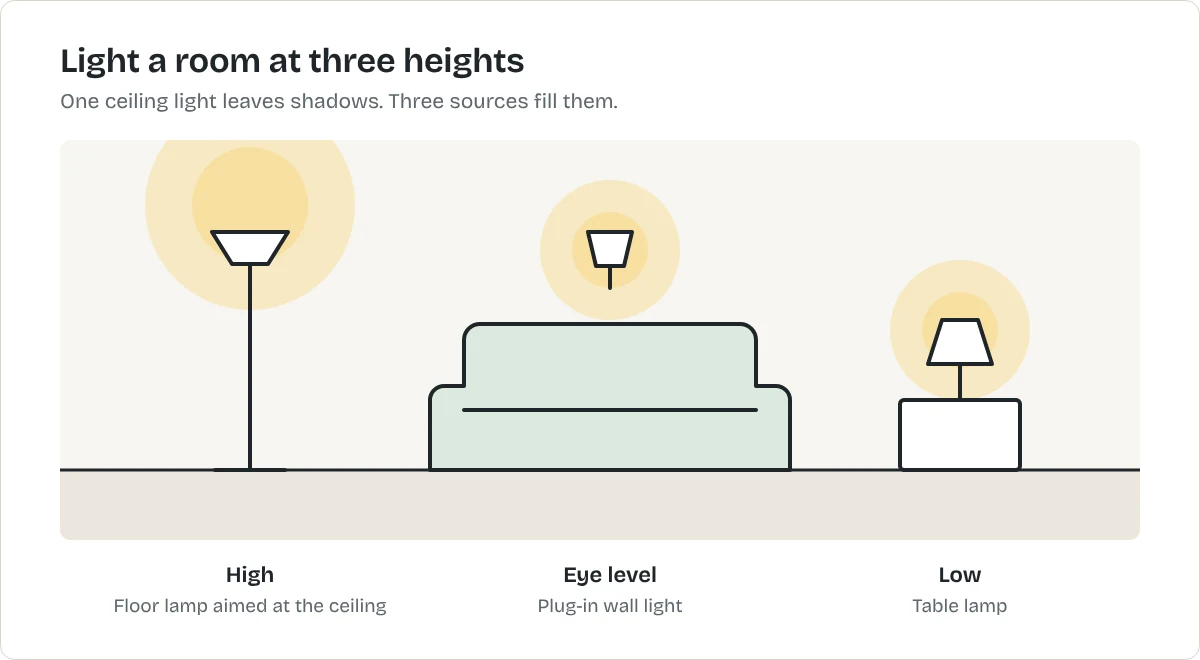
- High: a floor lamp that points up at the ceiling (an uplighter, or torchiere). The ceiling then acts as one large, soft light. This is the best stand-in for a missing ceiling fitting.
- Eye level: a wall light or a lamp on a shelf.
- Low: a table lamp beside the sofa or bed.
Wall lights with no wiring
Plug-in wall sconces give you light at eye level and free up table space. They hang on a small bracket and run a cord down to a socket. A cord cover painted to match the wall hides the cable.
If your lease bans screws, a light sconce can hang on adhesive strips instead. Check the weight first: what adhesive hooks and strips really hold gives the limits.
Dark kitchens, wardrobes and hallways
Rechargeable stick-on lights fix the small dark spots. Motion-sensor bars suit wardrobes and the space under kitchen cabinets. They attach with a magnetic strip and charge by USB, so nothing is wired in. For more on that under-cabinet space, see how to organize a tiny apartment kitchen.
Put the lamps on a schedule
A lamp you have to cross the room to switch on stays off. A smart plug turns any lamp on at dusk and off at bedtime; smart plugs for beginners explains how. LED lamps cost very little to run, and you can check the figure for your own bulbs with the electricity cost calculator.
Products that can help
Start with bulbs, because they improve lamps you already own.
Best for making a lamp you already own twice as bright
100-watt-equivalent LED bulb (about 1,600 lumens)
The quickest lighting upgrade: swap an 800-lumen bulb for one of about 1,600 lumens. This is a type of product, not one model. The button opens the retailer's results for it, so compare a few before you choose.
What we like
- Roughly doubles the light from a 60-watt-equivalent bulb
- Uses far less power than an old 100-watt bulb
- Nothing to install: it fits the lamp you have
What to know
- Fittings differ by country: screw (E26) in the US, bayonet (B22) or screw (E27) in the UK
- Check the lamp's maximum wattage label and whether you need a dimmable bulb
- Daylight versions can feel harsh in a living room at night
- Brightness to look for
- About 1,600 lumens
- Colour for living rooms
- 2,700K to 3,000K (warm white)
United States
United Kingdom
Not listed with our CA retailers yet.
Not listed with our AU retailers yet.
Research-based recommendation: we have not tested this product ourselves. How we evaluate products. Details checked October 2026.
Best for light at eye level without wiring
Plug-in wall sconce with cord and switch
A wall light that hangs on a small bracket and plugs into an ordinary socket. This is a type of product, not one model. The button opens the retailer's results for it, so compare a few before you choose.
What we like
- Adds a light source at eye level, where rooms usually have none
- Frees up table and floor space
- Leaves with you when you move
What to know
- The cord shows unless you add a cord cover
- Most need two small screws; check your lease, or choose a light model and use adhesive strips within their weight limit
- Bulbs are often sold separately
United States
United Kingdom
Not listed with our CA retailers yet.
Not listed with our AU retailers yet.
Research-based recommendation: we have not tested this product ourselves. How we evaluate products. Details checked October 2026.
Best for dark worktops, wardrobes and hallways
Rechargeable motion-sensor under-cabinet light
A slim light bar that sticks on with a magnetic strip and charges by USB. This is a type of product, not one model. The button opens the retailer's results for it, so compare a few before you choose.
What we like
- No wiring and no drilling
- Switches on only when you are there
- Lifts off its magnetic strip for charging
What to know
- Needs recharging; how often depends on use
- Adhesive strips hold poorly on greasy or textured surfaces
- Brightness varies widely between models: check the lumens
United States
United Kingdom
Not listed with our CA retailers yet.
Not listed with our AU retailers yet.
Research-based recommendation: we have not tested this product ourselves. How we evaluate products. Details checked October 2026.
A simple order of work
- Do the five free fixes.
- Upgrade the bulbs in lamps you own.
- Add an uplighter in the darkest corner.
- Add eye-level light with plug-in sconces.
- Light the small dark spots with stick-on bars.
Stop when the room feels right. Many people are done after step three. For the rest of the room, see how to make a small apartment feel bigger.
Frequently asked questions
How many lumens does a living room need?
There is no single number, because room size and wall colour change the answer. As a starting point, three lamps of 800 to 1,600 lumens each light a small living room well. Add or remove one after a week of living with it.
Is warm white or daylight better for a dark room?
Daylight bulbs look brighter but can feel cold in the evening. Warm white at a higher lumen count gives brightness without the harsh tone. Use daylight bulbs for a desk or a windowless kitchen.
Can I add wall lights in a rental?
Yes, if they plug in. Plug-in sconces need only a small bracket or adhesive strips, and they leave with you when you move.
Do mirrors really make a room brighter?
A mirror does not create light; it redirects it. Placed opposite or beside a window, it sends daylight to parts of the room the window cannot reach.
Are LED bulbs expensive to run?
No. ENERGY STAR says certified LED bulbs give the same brightness for up to 90 percent less energy than standard bulbs.