The Ultimate Renter's Guide
Everything about making a rented home work, in one place: reading your lease, upgrading without losing your deposit, storage without drilling and moving out cleanly.
In this article
Start here
Renting means living somewhere you cannot fully change. That is less limiting than it sounds: light, colour, storage and furniture all move with you. This guide sets out what to do from move-in to move-out and links to the detailed article for each step.
Know what you can change
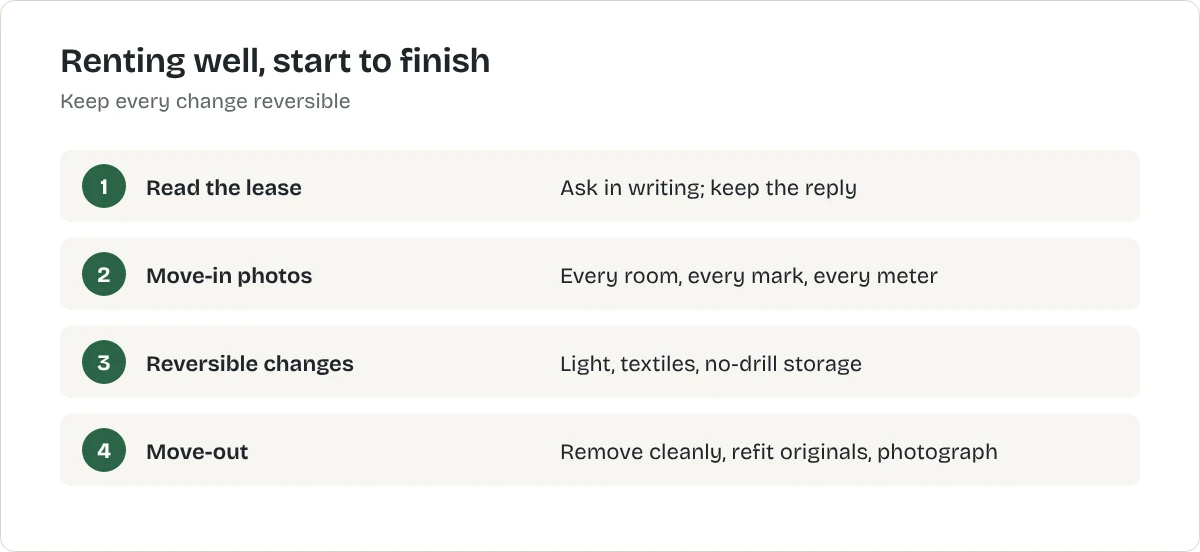
Read your lease before you buy anything that sticks to, hangs on or fixes into the building. Ask in writing for anything unclear, and keep the reply.
Make it feel like yours
Light first, then textiles, then a feature wall if allowed.
Storage without drilling
Use under the bed, behind doors, the top half of cupboards and freestanding shelving. Know what adhesive products really hold before you trust them.
A smart home you can take with you
Plugs, bulbs and sensors that need no wiring.
Moving in and moving out
- Move-in: photograph every room, including marks and meter readings. Note anything broken in writing to your landlord or agent within the time your lease allows.
- During: report repairs promptly in writing; damp, broken fans and faulty heating are usually the landlord's responsibility.
- Move-out: remove adhesive products by pulling the tab slowly down along the wall, refit originals, clean, and photograph again.
Before a move, measure every large item and the route out and in: will it fit? how to measure for a sofa applies to beds and wardrobes too. The moving cost calculator helps you budget.
Putting it together
Read the lease, photograph everything, keep changes reversible, and keep every original fitting labelled. Do that, and you can make a rental feel like home and still get your deposit back.
Keep reading
Your rights, briefly
Rights differ by country, state and city, so check official guidance where you live. In England, the first phase of the Renters' Rights Act 2025 began on 1 May 2026: section 21 "no fault" evictions are abolished, tenancies become rolling periodic tenancies, rent can rise only once a year through a set process, and tenants can ask to keep a pet, which landlords must consider reasonably. In the US, tenant protections are set by states and cities and vary widely; your local housing authority is the place to check.
Keep a renter's file
Keep one folder, paper or digital, with your lease, move-in photos, the inventory, receipts for anything you bought for the flat, every written request and reply, and repair reports. It takes ten minutes to set up and is the single most useful thing when a question about repairs or your deposit comes up.
Before you sign
Read the whole lease. Check who is responsible for repairs, what the notice period is, whether pets are allowed, and what happens to the deposit. Ask what the bills are likely to cost. View the property at different times of day if you can, to see light and hear noise.
Moving out
Give notice in writing as your lease requires. Clean thoroughly, put back anything you changed, and take dated photos of every room. Return all keys and get a receipt, give your new address, and take final meter readings. Keep these records until your deposit is returned in full.
Frequently asked questions
What can I change in a rented apartment?
It depends on your lease and local law. Anything that plugs in, stands up or hangs without fixings is almost always fine; painting, wallpaper and fixings usually need permission.
How do I protect my deposit?
Photograph every room at move-in and move-out, keep receipts and correspondence, test adhesive products first and refit any originals before you leave.
Have UK renters' rights changed?
In England, the first phase of the Renters' Rights Act 2025 began on 1 May 2026, ending section 21 no-fault evictions and moving tenancies to rolling periodic terms. Check official guidance for details.
Sources
Related articles
Renter-Friendly Solutions
Best Renter-Friendly Apartment Upgrades
Upgrades that change how a rental looks and works, and come out without a trace: better light, removable wallpaper, no-drill hanging and smarter switches.

Renter-Friendly Solutions
Best No-Drill Shelving
Shelves for renters that carry real weight without a drill: leaning ladder shelves, tension poles and over-the-toilet racks, and why adhesive shelves are not on the list for books.
Renter-Friendly Solutions
Best Removable Wallpaper
Peel-and-stick or non-woven paste-the-wall: how the two kinds of removable wallpaper compare for renters, and the test to do before you cover a whole wall.