Will It Fit? How to Measure for a Sofa Before You Buy
Most returned sofas fit the room but never reached it. Measure the room, the route and the sofa in 15 minutes, including the one measurement most shoppers miss.
In this article
Why sofas get stuck
Most sofas that get sent back fit the room perfectly. They just never reached it. The door, the hallway turn or the lift stopped them.
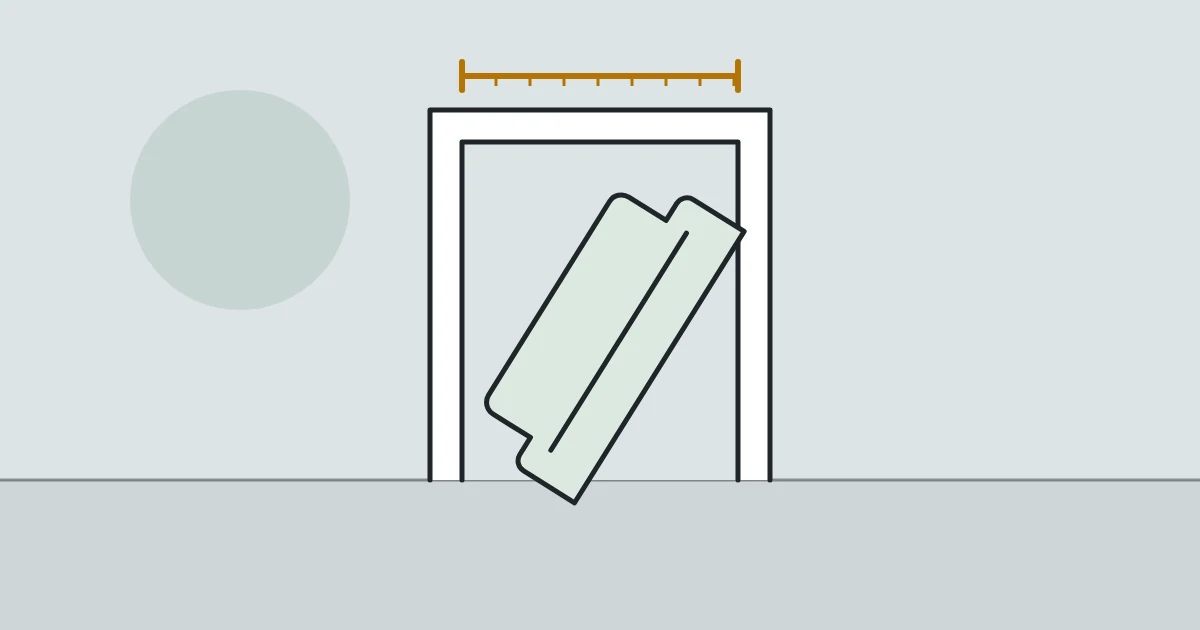
A product page lists width, depth and height. None of those tells you whether the sofa can tilt through a doorway. Delivery crews angle a sofa to get it in, so the number that matters is its diagonal depth. Retailers such as Crate & Barrel and Pottery Barn build their delivery guides around it.
The second cause is the route. People measure the front door and forget the hallway behind it, the stair turn and the lift.
Checking takes about 15 minutes and three sets of measurements: the room, the route and the sofa.
What you need
A metal tape measure, a roll of painter's tape, a pen and your phone for notes. A stiff, locking tape lets one person measure a doorway alone.
Step 1: Measure the room
- Measure the wall where the sofa will sit.
- Note anything that sticks out: radiators, skirting boards (baseboards), sockets and window sills.
- Mark the sofa's width and depth on the floor with painter's tape.
- Walk around the taped outline for a day. If you keep stepping on it, the sofa is too big.
As a working guide, leave about 30 inches (75 cm) for a main walkway and about 16 inches (40 cm) between the sofa and a coffee table. These are common rules of thumb, not fixed rules, and a tight room can go a little lower on a path you rarely use.
Step 2: Measure the route
Start at the street and walk the path the sofa will take. At every point, write down the narrowest width and the lowest height.
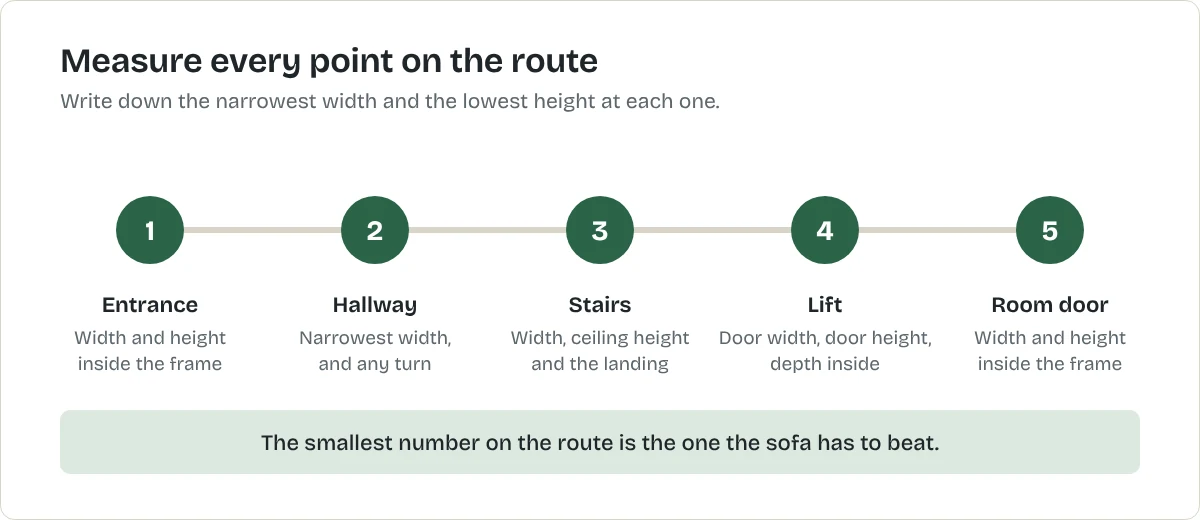
- Building entrance and your front door. Measure the opening inside the frame, not the door itself.
- Hallways, including any turn. Note what is fixed to the walls, such as light fittings and handrails.
- Stairs. Width, ceiling height at the top and bottom, and the size of the landing.
- Lift. Door width, door height and the depth inside.
- The room door.
Step 3: Find the sofa's diagonal depth
Some retailers list diagonal depth. If yours does not, measure it on a showroom model or ask the seller.
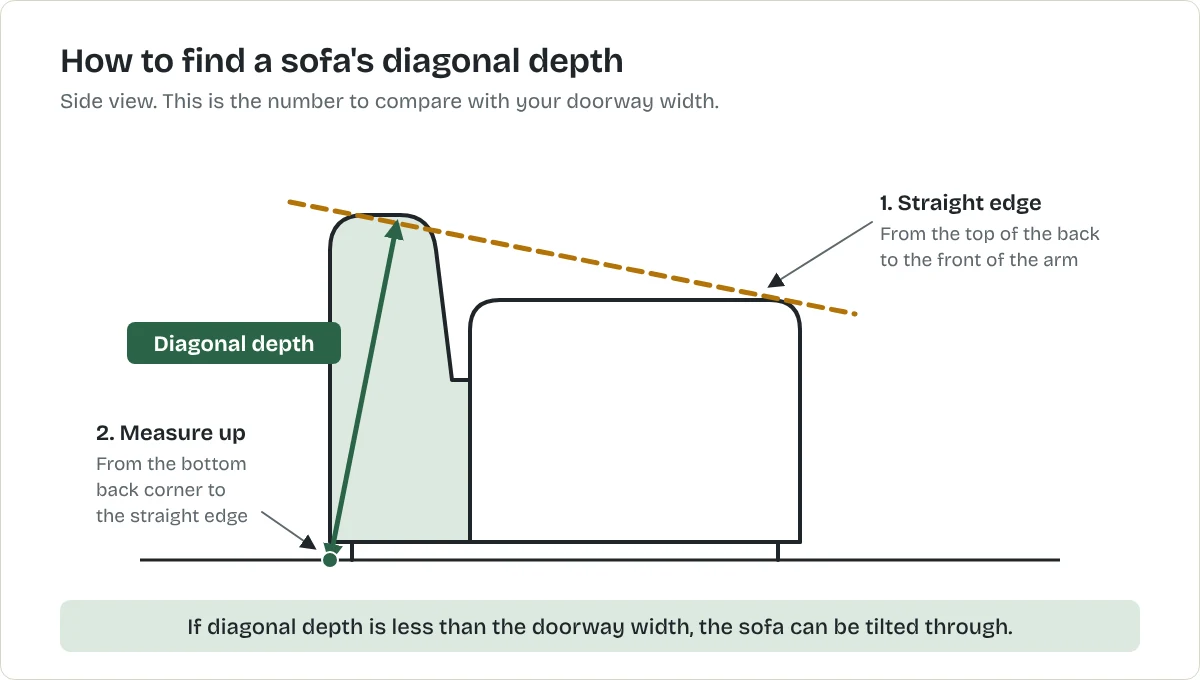
- Lay a straight edge from the highest point of the sofa's back to the front of the arm.
- Measure from the bottom back corner of the sofa up to that straight edge.
- That distance is the diagonal depth.
Step 4: Compare the numbers
| Sofa measurement | Must be smaller than |
|---|---|
| Width (arm to arm) | Doorway height, if the sofa is carried in on its end |
| Diagonal depth | Doorway width |
| Depth or height | Hallway width, with room for hands |
The key test: diagonal depth must be less than the doorway width. If it is, the sofa can be tilted through. The furniture fit calculator runs the same check for the room and the door in one go.
If the numbers do not work
You have four options before giving up on a sofa.
- Remove the feet. Most unscrew and save a few centimetres.
- Take the door off its hinges. This adds the thickness of the door to the opening. In a rental, ask your landlord first.
- Choose a modular sofa. It arrives in boxes, one seat at a time.
- Choose a narrower model. Apartment-size sofas are built for this; how to choose furniture for a small apartment covers what to look for.
Products that can help
Best for narrow doors, stairs and lifts
Modular sofa that ships in boxes
A sofa delivered as separate seats and assembled in the room. This is a type of product, not one model. The button opens the retailer's results for it, so compare a few before you choose.
What we like
- Each box passes through doorways a one-piece sofa cannot
- Sections can be rearranged or added later
- Easier to move to the next home
What to know
- Check the largest box against your narrowest doorway
- Comfort and build quality vary a lot: read the return terms before ordering
- Joins between sections can shift on smooth floors
United States
United Kingdom
Not listed with our CA retailers yet.
Not listed with our AU retailers yet.
Research-based recommendation: we have not tested this product ourselves. How we evaluate products. Details checked October 2026.
Best for moving heavy furniture on hard floors
Felt furniture sliders
Pads that sit under furniture feet so a sofa or bed slides without scratching. This is a type of product, not one model. The button opens the retailer's results for it, so compare a few before you choose.
What we like
- Protects wood, laminate and tile floors, and your deposit
- Lets one person nudge a sofa into place
- Cheap and reusable
What to know
- Felt is for hard floors; carpet needs smooth plastic sliders
- Felt picks up grit, which can scratch: wipe pads before use
- Furniture still has to be lifted onto them
United States
United Kingdom
Not listed with our CA retailers yet.
Not listed with our AU retailers yet.
Research-based recommendation: we have not tested this product ourselves. How we evaluate products. Details checked October 2026.
What to do next
A sofa is usually the largest thing you own, so it decides where everything else goes. If a desk has to share the room, see how to build a home office in a small bedroom. If you are moving and want to know what the whole job costs, try the moving cost calculator.
Frequently asked questions
What is diagonal depth on a sofa?
It is the distance from the bottom back corner of the sofa to a straight line drawn between the top of the back and the front of the arm. It tells you whether the sofa can be tilted through a doorway.
How wide does a door need to be for a sofa?
Wider than the sofa's diagonal depth. There is no universal number, so measure your own door and check the sofa's figure.
Will a sofa fit if it is wider than my door?
Usually yes. Sofas go through doors on their end or at an angle, so width matters far less than diagonal depth.
How much space should I leave around a sofa?
About 30 inches (75 cm) for a main walkway is a comfortable guide. Small rooms can work with less on a path you use rarely.
What if I buy online and it does not fit?
Check the return policy before you order. Large items often carry a collection fee, which is one more reason to measure first.
Sources
Related articles
Small-Space Furniture
Small Space Furniture Buying Guide
How to choose furniture for a small home: measure the room and the route, choose pieces that earn their space, and avoid the mistakes that make rooms feel smaller.
Small-Space Furniture
Best Sleeper Sofas
A pull-out sleeper, a click-clack sofa bed or a futon: which suits a small apartment depends on how often guests stay and how often you sit on it.
Small-Space Furniture
How to Choose Furniture for a Small Apartment
What to measure, which features earn their floor space and how to avoid the sofa that will not fit through the door.