Best Steam Mops
A steam mop suits sealed tile and most vinyl, but not wood, laminate or linoleum. Here is how a steam mop, a spray mop and a flat microfibre mop compare by floor type.

In this article
The short answer
- Tile and most vinyl: a steam mop cleans without detergent.
- Wood, laminate or a mix of floors: a spray mop that uses a light mist.
- One mop for every floor, lowest cost: a flat microfibre mop used barely damp.
Check your floor before anything else: the wrong mop can void a floor warranty or cost you a deposit.
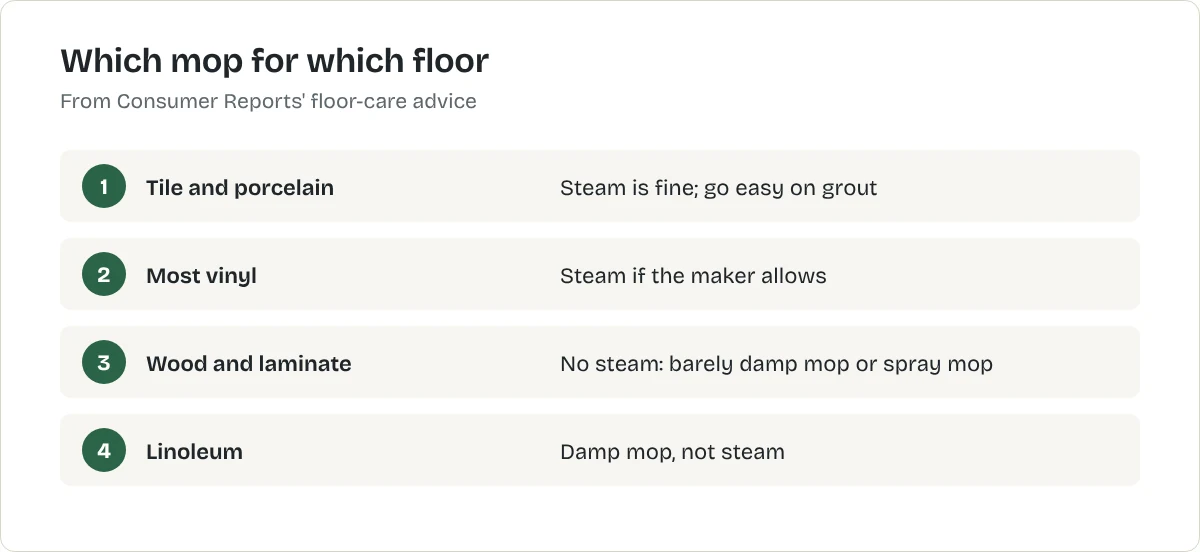
Which floors can take steam?
Consumer Reports advises:
- Wood (solid, engineered or bamboo, sealed or not): avoid steam. Heat and moisture can warp it.
- Laminate: avoid steam. Heat can damage the surface and moisture can swell the fibreboard core.
- Vinyl: most is fine, but check your flooring and mop manuals, as some backings are heat-sensitive.
- Ceramic and porcelain tile: fine, but limit steam on grout, which heat and moisture can loosen over time.
- Linoleum: use a damp mop, not steam.
If you rent and do not know what the floor is, ask your landlord or use a barely damp microfibre mop, which is safe on all of them.
Side by side
| Product | Best for | Price | Where to buy |
|---|---|---|---|
| Steam mop | sealed tile and vinyl floors | US: See retailerUK: See retailerCA: See retailerAU: See retailerChoose a country | United States
United Kingdom
Not listed with our CA retailers yet. Not listed with our AU retailers yet. Where are you shopping? |
| Spray mop | quick cleans on most hard floors | US: See retailerUK: See retailerCA: See retailerAU: See retailerChoose a country | United States
United Kingdom
Not listed with our CA retailers yet. Not listed with our AU retailers yet. Where are you shopping? |
| Microfibre flat mop with washable pads | renters who want one mop for every floor | US: See retailerUK: See retailerCA: See retailerAU: See retailerChoose a country | United States
United Kingdom
Not listed with our CA retailers yet. Not listed with our AU retailers yet. Where are you shopping? |
Swipe sideways to see every column.
Where they differ
Cleaning power
Steam loosens dried-on dirt on tile without detergent. Spray mops and flat mops rely on a cleaning solution and a bit more effort for sticky spots.
Floor safety
Spray mops and barely damp flat mops use little water, so they suit wood and laminate. Steam does not.
Storage and running cost
All three store in a narrow gap. Steam mops need a socket in reach. Pads for all three are washable; spray mops need refills of a floor-safe solution unless the tank takes your own.
The picks in detail
Best for sealed tile and vinyl floors
Steam mop
A mop that heats water and cleans with steam through a washable pad. This is a type of product, not one model. The button opens the retailer's results for it, so compare a few before you choose.
What we like
- Cleans without detergent
- Good on tile and many vinyl floors
- Washable pads
What to know
- Not for wood, laminate or linoleum floors
- Heat and moisture can loosen grout over time
- Corded models need a socket in reach
United States
United Kingdom
Not listed with our CA retailers yet.
Not listed with our AU retailers yet.
Research-based recommendation: we have not tested this product ourselves. How we evaluate products. Details checked October 2026.
Best for quick cleans on most hard floors
Spray mop
A flat mop with a refillable tank that sprays a light mist ahead of the pad. This is a type of product, not one model. The button opens the retailer's results for it, so compare a few before you choose.
What we like
- Uses little water: safer for wood and laminate
- Light and quick
- Stores in a narrow gap
What to know
- Weaker on dried-on dirt than steam
- Use a floor-safe solution
- Pads need washing
United States
United Kingdom
Not listed with our CA retailers yet.
Not listed with our AU retailers yet.
Research-based recommendation: we have not tested this product ourselves. How we evaluate products. Details checked October 2026.
Best for renters who want one mop for every floor
Microfibre flat mop with washable pads
A flat mop used with a barely damp microfibre pad. This is a type of product, not one model. The button opens the retailer's results for it, so compare a few before you choose.
What we like
- Safe on every common floor when used barely damp
- Pads wash and reuse
- Cheapest option
What to know
- You rinse and wring pads by hand
- More effort on sticky dirt
- Needs a bucket or sink
United States
United Kingdom
Not listed with our CA retailers yet.
Not listed with our AU retailers yet.
Research-based recommendation: we have not tested this product ourselves. How we evaluate products. Details checked October 2026.
How to mop a small apartment quickly
- Vacuum or sweep first, or the mop just moves grit around.
- Start at the far corner and work back towards the door.
- Use a clean pad for each room, or rinse as you go.
- Leave windows open or the fan on so floors dry quickly.
Mistakes to avoid
- Steam on wood or laminate.
- Too much water on any floor that is not tile.
- Holding a steam mop in one place. Keep it moving.
- Dirty pads. Wash them after every use.
Using a steam mop safely
Let it heat fully before use, keep it moving so heat does not sit on one spot, and never leave it standing on the floor while switched on. Use distilled or filtered water if the maker recommends it, to reduce scale. Let floors dry before walking on them, and keep children and pets away while you work, as the head and steam are hot.
Pads and cleaning
Most steam mops use washable microfibre pads. Have two or three so you can swap when one gets dirty. Wash them hot without fabric softener, which reduces how well they pick up dirt. Empty the water tank after each use so it does not go stale.
Floors to check first
Sealed tile and vinyl are usually fine. For anything else, check the floor maker's guidance and any notes in your lease, and test in a hidden corner.
Which should you choose?
Tile and vinyl: steam. Wood and laminate: spray mop. Mixed or unknown floors: a microfibre flat mop. Vacuum before you mop; robot vacuum or cordless stick helps you choose the vacuum. For the rest of your routine, see the apartment cleaning guide and the weekly cleaning checklist.
How we chose
These are research-based recommendations: we compared published specifications, maker documentation and the features that matter in a small home. We have not tested them hands-on. Most picks are types of product rather than single models, so the buttons open the retailer's results; compare a few listings before you buy, in your own country's store.
Frequently asked questions
Can I use a steam mop on laminate?
Consumer Reports advises against it: heat can damage laminate's surface, and moisture can swell its fibreboard core. Use a barely damp mop instead.
Can I use a steam mop on hardwood?
Consumer Reports advises avoiding steam on wood floors, sealed or not, because heat and moisture can warp them.
Which floors suit a steam mop?
Ceramic and porcelain tile, and most vinyl. Check the vinyl maker's guidance, and limit steam on grout.
Sources
Related articles

Cleaning
Best Robot Vacuums for Apartments
A budget robot, a mapping robot or a self-emptying robot: which suits an apartment depends on your floors, your pets and where the dock can go.

Cleaning
Best Products for Pet Hair
Pet hair builds up fastest on sofas, rugs and bedding. A rubber broom, a reusable roller and the right vacuum handle most of it without endless lint rollers.

Cleaning
Best Cordless Vacuums
For a small apartment, a light cordless stick handles floors and sofas; a handheld covers quick spills. What to check: real runtime, weight, battery and storage.