What Can a Tenant Change? Reading Your Lease
What you can change in a rented home depends on your lease and local law. How to read the clauses that matter, what is usually allowed, and how to ask for permission.
In this article
- What you need to know first
- Step 1: Find the clauses that matter
- Step 2: Sort changes into three groups
- Step 3: Ask in writing
- Step 4: Know what has changed for UK renters
- Step 5: Protect your deposit
- Common mistakes to avoid
- What to do next
- How to ask for permission
- Things usually allowed without asking
- Things that usually need permission
- When it goes wrong
- Frequently asked questions
What you need to know first
There is no single answer to what a tenant can change: it depends on your lease and on where you live. In the US, rules vary by state and city. In the UK, they differ between England, Scotland, Wales and Northern Ireland. What is consistent is the approach: read the lease, ask in writing, and keep every change reversible. This is general information, not legal advice; check official guidance or get advice for your situation.
Step 1: Find the clauses that matter
Search your lease or tenancy agreement for these words:
- Alterations or improvements: usually says you need written consent for any change.
- Decorating or decoration: painting, wallpaper and sometimes nails.
- Fixtures and fittings: what belongs to the landlord, such as light fittings, shower heads and blinds.
- Damage and wear and tear: what you pay for at the end.
- Pets, smoking and subletting: often separate clauses.
Step 2: Sort changes into three groups
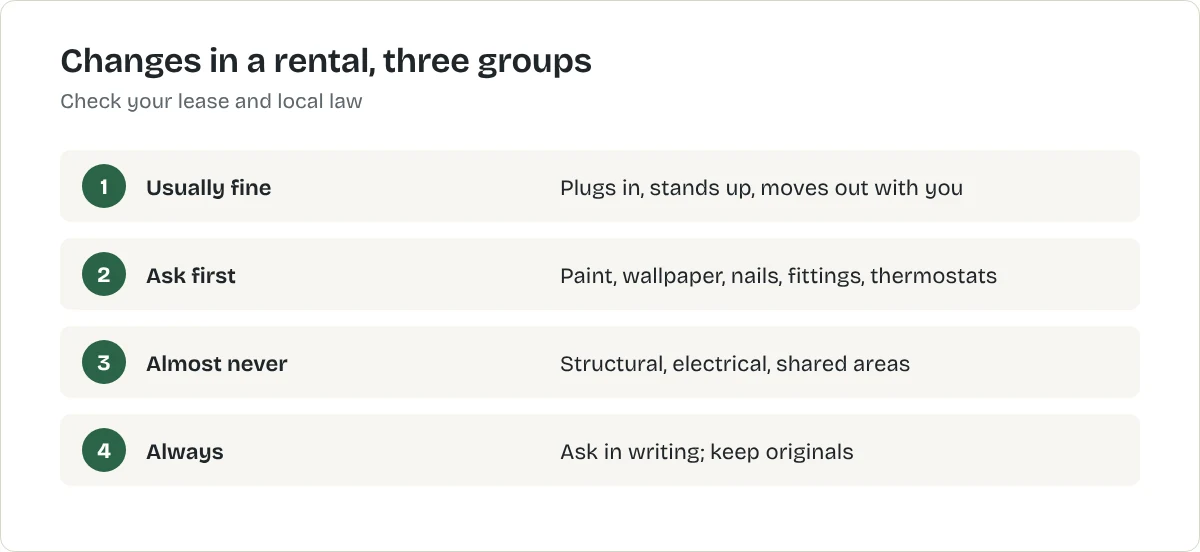
Usually fine without asking: anything that plugs in, stands up or moves out with you. Furniture, lamps, rugs, curtains on tension rods, plants, smart plugs and bulbs (keep the originals).
Usually needs permission: painting, wallpaper (even removable), nails and screws, wall-mounted shelves or TVs, changing light fittings, fitting a smart thermostat or lock, and swapping fixtures such as shower heads.
Almost never allowed without consent: structural changes, anything electrical beyond plugging in, removing fixtures, and changes to shared areas.
Step 3: Ask in writing
Email is fine. Say exactly what you want to do, how, and what you will do at the end of the tenancy. For example: "I would like to paint the living room in [colour] and will repaint it in the original colour before I leave." Keep the reply with your lease.
Step 4: Know what has changed for UK renters
In England, the Renters' Rights Act 2025 began its first phase on 1 May 2026. Section 21 "no fault" evictions are abolished, assured shorthold tenancies become rolling periodic tenancies, rent can rise only once a year through a set process, and tenants can ask to keep a pet, which landlords must consider reasonably and answer within set timeframes. Check your local council or GOV.UK for the details that apply to you.
Step 5: Protect your deposit
- Photograph every room when you move in, including marks and meter readings.
- Keep every original fitting you replace, labelled.
- Test adhesive products on a hidden spot first: what adhesive hooks and strips really hold.
- Undo agreed changes before you leave unless the landlord says otherwise in writing.
Common mistakes to avoid
- Assuming removable means allowed.
- Verbal permission. Get it in writing.
- Throwing away originals.
- Ignoring local law. Some rights apply whatever the lease says.
What to do next
Once you know what is allowed, see how to upgrade an apartment without renovating and best renter-friendly apartment upgrades. The ultimate renter's guide brings it all together.
How to ask for permission
Write to your landlord or agent with exactly what you want to change, how you will do it, and that you will restore it when you leave if they want. Attach a photo or product link. Keep the reply. Verbal permission is easy to forget or dispute later.
Things usually allowed without asking
Furniture, rugs, curtains on existing rails, lamps, plug-in smart devices, freestanding storage and decorations hung with removable strips within their weight limits. Remove strips carefully before you leave.
Things that usually need permission
Painting, drilling, changing locks, fitting shelves or TV brackets, changing light fittings, replacing appliances or fixtures, and anything electrical or plumbing. Wiring work should be done by a qualified electrician.
When it goes wrong
If you change something without permission, the landlord may deduct the cost of putting it back from your deposit. Restoring it yourself before you leave, to a good standard, is usually cheaper.
Frequently asked questions
Can I paint my rented apartment?
Usually only with written permission. Many landlords agree if you use a colour they approve or agree to repaint before you leave.
Can I put nails in the walls?
Check your lease. Some allow a small number of picture hooks; many treat any hole as damage. Adhesive strips are the safe alternative for light items.
Can I have a pet in a rented home?
It depends on your lease and local law. In England, the first phase of the Renters' Rights Act 2025, from 1 May 2026, lets tenants request permission for a pet, which landlords must consider reasonably.
Sources
Related articles

Renter-Friendly Solutions
How to Upgrade an Apartment Without Renovating
You can change how an apartment looks and works without a builder or a drill: light, colour, textiles, storage and small swaps you can reverse. Here is the order to do it in.
Renter-Friendly Solutions
Best Renter-Friendly Apartment Upgrades
Upgrades that change how a rental looks and works, and come out without a trace: better light, removable wallpaper, no-drill hanging and smarter switches.

Renter-Friendly Solutions
The Ultimate Renter's Guide
Everything about making a rented home work, in one place: reading your lease, upgrading without losing your deposit, storage without drilling and moving out cleanly.