How to Improve Air Quality in a Small Apartment
Stuffy, damp or dusty air has causes you can fix. Start with the source and with ventilation; an air purifier comes third, and only helps if it is the right size for the room.
In this article
Why the air in a small apartment gets stale
Small homes have less air to dilute whatever goes into it, and many apartments have windows on only one side, so air does not flow through. Cooking, showering, cleaning products, candles, dust and damp all add up quickly.
The US Environmental Protection Agency describes three basic strategies for better indoor air, in this order: control the source, improve ventilation, and then clean the air. The order matters. A purifier running in a damp, unventilated room is treating the symptom.
Step 1: Deal with the source
- Cooking. Use lids, and run the extractor (range) hood whenever you fry or boil. If the hood only recirculates, open a window too.
- Moisture. Run the bathroom fan during a shower and for a while afterwards. Dry laundry near an open window or with the fan running, not in a closed bedroom.
- Smoke and fragrance. Smoking indoors, candles, incense and heavily scented sprays all add particles and chemicals. Use them less, or not at all.
- Dust. Vacuum floors and soft furniture regularly, and wash bedding weekly. A short routine is in how to keep a small apartment clean, and robot vacuum or cordless stick helps you pick a vacuum for a small home.
- Shoes. Leaving them at the door keeps a surprising amount of dirt out.
Step 2: Ventilate
Fresh air is free. Opening windows wide for ten to fifteen minutes, morning and evening, changes the air without losing much heat. If you have windows on two sides, open both to pull air through. Keep trickle vents open and never block extractor fans or vents.
If you live on a busy road, ventilate at quieter times of day and use the windows facing away from traffic where you can.
Step 3: Control humidity
Air that is too damp encourages mould and dust mites; air that is too dry is uncomfortable. The EPA advises keeping indoor relative humidity below 60 percent, ideally between 30 and 50 percent. An inexpensive hygrometer tells you where you stand.
- Too damp: ventilate more, use extractor fans, keep furniture slightly away from cold outside walls, and consider a dehumidifier sized for the room.
- Too dry: a humidifier can help in winter. Clean it as the maker directs, because a dirty humidifier puts more into the air than water.
Step 4: Decide whether you need an air purifier
A portable air purifier with a true HEPA filter removes fine particles such as dust, pollen, pet dander and smoke from the air that passes through it. It does not remove moisture, and it does not replace ventilation. If dust, pollen or smoke are still a problem after the first three steps, a purifier is worth considering.
Most disappointing purifiers are simply too small for the room, so size is the first thing to get right.
CADR: the number that matters
CADR stands for clean air delivery rate: the volume of filtered air a purifier delivers. The Association of Home Appliance Manufacturers (AHAM) runs the standard test and publishes separate scores for smoke, dust and pollen. A higher number means the purifier cleans the air faster.
In the US, CADR is given in cubic feet per minute (cfm). In the UK and Europe it is usually given in cubic metres per hour (m³/h). One cfm is about 1.7 m³/h.
Be wary of a large "covers up to" figure on the box. It may assume the purifier cleans the air only once an hour, on its loudest setting.
The two-thirds rule
AHAM's rule of thumb: the purifier's smoke CADR should be at least two-thirds of the room's floor area in square feet. AHAM's own example is a 10 × 12 foot room, which is 120 square feet and needs a smoke CADR of at least 80. In metric, that works out to roughly 12 m³/h of CADR for every square metre of floor.
Two adjustments apply:
- Wildfire smoke. AHAM recommends a smoke CADR equal to the full room area in square feet, not two-thirds.
- High ceilings. The rule assumes an 8-foot (2.4 m) ceiling. If yours is higher, choose a purifier rated for a larger room.
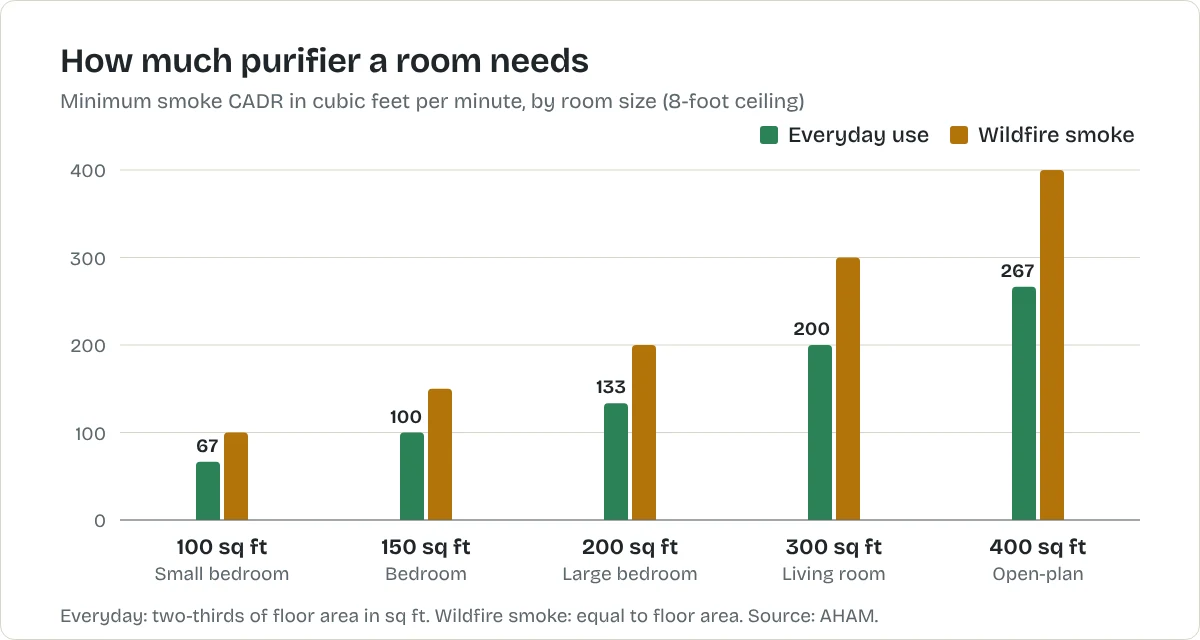
| Room size | Example | Minimum smoke CADR | For wildfire smoke |
|---|---|---|---|
| 100 sq ft (9 m²) | Small bedroom | 67 cfm (113 m³/h) | 100 cfm (170 m³/h) |
| 150 sq ft (14 m²) | Bedroom | 100 cfm (170 m³/h) | 150 cfm (255 m³/h) |
| 200 sq ft (19 m²) | Large bedroom or studio living area | 133 cfm (227 m³/h) | 200 cfm (340 m³/h) |
| 300 sq ft (28 m²) | Living room | 200 cfm (340 m³/h) | 300 cfm (510 m³/h) |
| 400 sq ft (37 m²) | Open-plan living space | 267 cfm (453 m³/h) | 400 cfm (680 m³/h) |
The air purifier room size guide gives the CADR target for your own room.
What else to check
- Go one size up for a bedroom. CADR is measured at the highest, loudest fan speed. A purifier that exceeds your target can run on a quieter setting and still clean the room.
- Noise level on the setting you will actually use. A purifier that is too loud to sleep beside gets switched off.
- Filter cost and availability. Filters need replacing; check the price and interval before you buy.
- Certification. In the US, the AHAM Verifide mark means the CADR was independently tested.
- No ozone. The EPA advises avoiding air cleaners that intentionally produce ozone, which irritates the lungs.
Place the purifier in the room where you spend the most time, usually the bedroom, clear of curtains and furniture. It works best running continuously on a low setting; what do your appliances cost to run? shows what that costs.
Products that can help
Best for bedrooms up to about 200 sq ft
Levoit
Levoit Core 300S Smart Air Purifier
A compact, app-controlled air purifier with a three-stage filter. Specifications below are for the US model (Core 300S-P); check the listing for your country, as versions differ.
- App control, schedules and timers
- Sleep mode
- Listed by the maker as ozone free
What we like
- By the two-thirds rule, its stated CADR suits rooms up to about 210 sq ft (19 m²)
- As quiet as 22 dB on its lowest setting, by the maker's figures
- Small footprint for a bedroom
What to know
- Too small for most living rooms
- The 1,000 sq ft figure in its marketing means one air change an hour, which is not enough for real cleaning
- Replacement filters are an ongoing cost: check the price first
- CADR (maker's figure)
- 141 cfm / 240 m³/h
- Room size at 4.8 air changes an hour
- 219 sq ft
- Noise
- 22 to 50 dB
- Rated power
- 23 W
- Size
- 8.7 × 8.7 × 14.2 in
United States
United Kingdom
Not listed with our CA retailers yet.
Not listed with our AU retailers yet.
Research-based recommendation: we have not tested this product ourselves. How we evaluate products. Details checked October 2026. Specifications from Levoit's US product page.
Other useful products:
- Hygrometer: shows humidity so you can stop guessing.
- Dehumidifier: for persistently damp rooms.
- Carbon monoxide alarm: essential if you have any fuel-burning appliance, and often a legal requirement.
Houseplants are pleasant to live with, but do not rely on them to clean the air; you would need far more than fits in an apartment.
When to ask your landlord
Report mould that keeps returning, extractor fans that do not work, windows that will not open and any smell of gas at once. Persistent damp is usually a building problem, and fixing it is the landlord's responsibility. If you smell gas, leave and call the emergency number for your gas supplier.
The bottom line
Remove what you can at the source, air the apartment daily, keep humidity in range, and add a purifier sized for the room if particles such as dust, pollen or smoke are still a problem. For more on comfort at home, see how to reduce noise in an apartment and the small apartment living guide.
Frequently asked questions
Do air purifiers actually work?
A HEPA air purifier sized for the room reduces airborne particles such as dust, pollen, pet dander and smoke. It does not remove humidity or gases well, and it works best alongside ventilation and source control.
What size air purifier do I need?
Multiply the room's floor area in square feet by two-thirds to get the minimum smoke CADR. A 150 square foot bedroom needs at least 100 cfm, which is about 170 m³/h.
What humidity level is best indoors?
The US EPA advises keeping relative humidity below 60 percent and ideally between 30 and 50 percent to discourage mould and dust mites.
How often should I open the windows?
Airing the apartment for ten to fifteen minutes at least once or twice a day is a good habit, and always during and after cooking, showering and cleaning.
Can one air purifier clean a whole apartment?
Not well. Walls and doors block airflow. Size the purifier for one room and move it, or use one in each room you spend the most time in.
Do houseplants clean indoor air?
Not enough to matter in a normal home. Ventilation and filtration do far more.