What Uses the Most Electricity at Home?
Heating and cooling come first in most homes, then water heating, then the fridge and lighting. Here is how to find out what uses the most in yours, US and UK.
In this article
- What you need to know first
- The big picture
- Step 1: List what makes heat or cold
- Step 2: Read the wattage and estimate hours
- Step 3: Measure the always-on things
- Step 4: Check your bill over the year
- What to change first
- Common mistakes to avoid
- What to do next
- How to find your own biggest users
- Where renters can save most
- Small users that add up
- Frequently asked questions
What you need to know first
Anything that makes heat or cold uses the most electricity. Electronics and LED lighting use far less than people expect; heaters, air conditioners, electric water heaters, tumble dryers, ovens and kettles use far more. Which matters most in your home depends on how it is heated and cooled.
The big picture
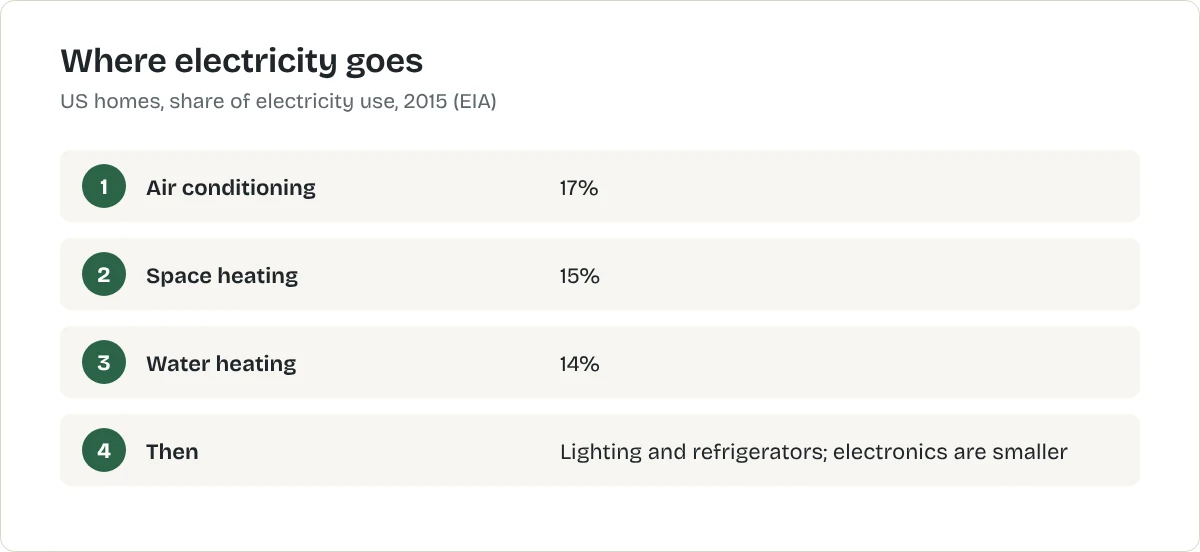
In the United States, the Energy Information Administration reported that the three largest uses of electricity in homes in 2015 were air conditioning (17%), space heating (15%) and water heating (14%), followed by lighting and refrigerators. Homes heated with gas use less electricity for heating; homes with electric heat and hot water use much more.
In the UK, most homes heat their rooms and water with gas, so heating does not appear on the electricity bill at all. Where it does, in flats with electric storage heaters, panel heaters or an electric shower, those are usually the biggest electricity users by far. After that come appliances that heat: tumble dryers, ovens and kettles.
Step 1: List what makes heat or cold
Go round your home and note every appliance that heats or cools: heaters, air conditioning, the water heater or electric shower, the oven, kettle, tumble dryer, iron, hair dryer and dehumidifier. These are your candidates.
Step 2: Read the wattage and estimate hours
The wattage is on each appliance's label. Multiply by the hours you use it, divide by 1,000 to get kWh, then multiply by your rate. What do your appliances cost to run? shows worked examples, and the electricity cost calculator does the sum.
Step 3: Measure the always-on things
A fridge, router, set-top box and anything on standby run all day. A plug-in energy monitor shows what they really use over a day or a week, which is often different from the label.
Best for finding out what one appliance really uses
Plug-in electricity usage monitor
A meter that sits between the socket and an appliance and shows its consumption. This is a type of product, not one model. The button opens the retailer's results for it, so compare a few before you choose.
What we like
- Measures real use over a day or week, not the label's maximum
- No app or Wi-Fi needed
- Moves from appliance to appliance
What to know
- Buy the version made for your country's sockets and voltage
- Small displays are hard to read behind furniture
- Accurate enough to compare appliances, not to check a bill
United States
United Kingdom
Not listed with our CA retailers yet.
Not listed with our AU retailers yet.
Research-based recommendation: we have not tested this product ourselves. How we evaluate products. Details checked October 2026.
Step 4: Check your bill over the year
Your bill shows usage month by month. A big winter jump points to heating; a summer jump points to cooling. How to read your electricity bill explains where to look.
What to change first
- Heat or cool less, and only where you are. A degree or two lower in winter makes a real difference, and heating one room beats heating the whole flat.
- Heat the person. A heated throw or electric blanket costs pennies an hour; see electric blanket vs space heater.
- Shorter hot showers if your water is heated electrically.
- Full loads in the washing machine and dryer.
- Standby last. It is real but small next to the items above.
Common mistakes to avoid
- Chasing phone chargers while a heater runs for hours.
- Trusting labels for cycling appliances such as fridges; measure them.
- Forgetting the fixed charge when comparing bills.
What to do next
Measure your top three candidates this week. Then see how much a space heater costs to run if you use one, and best energy-saving smart devices for tools that switch things off for you.
How to find your own biggest users
National averages are a starting point, but your home is different. A plug-in energy monitor, placed between the socket and an appliance for a day or a week, shows exactly how many kilowatt-hours it uses. Multiply by your unit rate and you have its cost. Check the fridge, the TV corner, any heater and the computer setup first. Many smart plugs also report energy use in their app.
Where renters can save most
You often cannot change the boiler, the windows or the fixed appliances. You can change how you use them: lower the thermostat by a degree, wash clothes at lower temperatures, fill the dishwasher, switch off standby at the wall and use a heated throw instead of heating an empty room. If an appliance supplied with the flat is very old and inefficient, it is worth asking the landlord whether they plan to replace it.
Small users that add up
Chargers, routers, set-top boxes and games consoles in standby each use little, but they run all day every day. A power strip with a switch, or a smart plug on a schedule, turns a whole cluster off at once.
Frequently asked questions
What uses the most electricity in a home?
Anything that heats or cools. In US homes in 2015, air conditioning, space heating and water heating were the three largest uses of electricity, according to the US Energy Information Administration.
Does the fridge use a lot of electricity?
It runs all day, so it adds up, but a modern fridge in good order uses far less than heating or cooling. An old or faulty one can use much more.
How do I find what uses the most in my home?
Use a plug-in energy monitor on each appliance for a day or a week, and check your bill's usage month by month.
Sources
Related articles
Energy & Money Saving
How Much Does a Space Heater Cost to Run?
A typical space heater costs far more per hour than a heated throw or electric blanket. Here is the sum at current US and UK rates, and how to run one safely and cheaply.
Energy & Money Saving
What Do Your Appliances Cost to Run?
Any appliance's running cost comes from one short formula and two numbers you already have. Here is the sum, worked examples, and what standby really costs.
Energy & Money Saving
Best Energy-Saving Smart Devices
Smart devices only save energy when they switch something off or heat less. These are the ones that do, for US and UK homes, and the claims to ignore.