Best Energy-Saving Smart Devices
Smart devices only save energy when they switch something off or heat less. These are the ones that do, for US and UK homes, and the claims to ignore.
In this article
The problem this solves
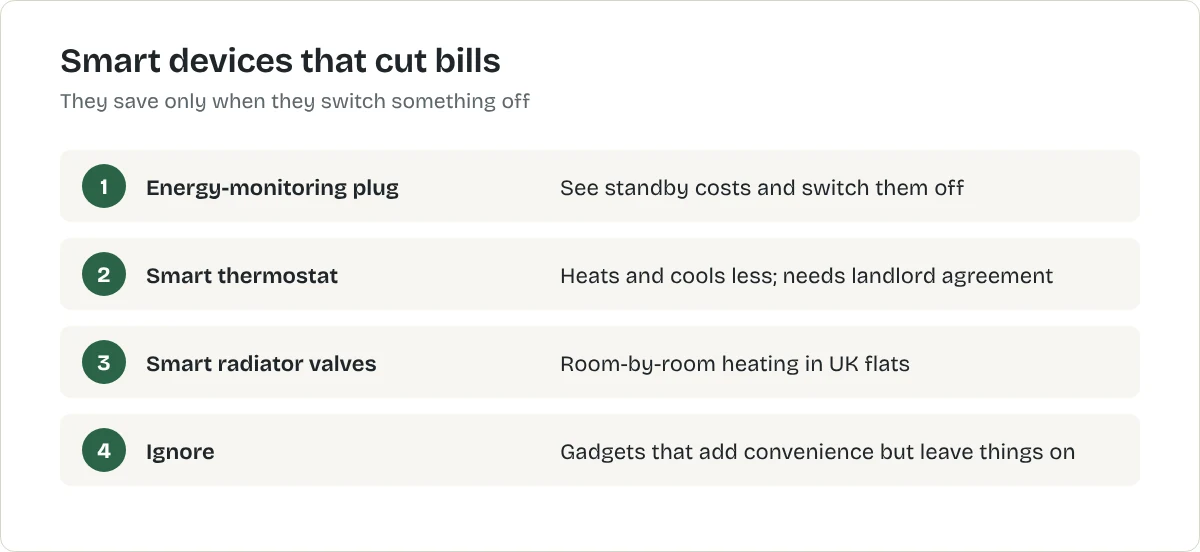
Smart devices are sold on convenience, and convenience can cost energy. The ones worth buying for your bill do one of two things: they show you where power goes, or they switch heating, cooling and standby devices off when you do not need them.
Try this before you buy anything
- Find out what costs the most. Heating and cooling dwarf everything else in most homes. What uses the most electricity at home? explains the order.
- Work out the sums. Watts × hours ÷ 1,000 × your rate. What do your appliances cost to run? shows how.
- Turn things down by hand. A lower thermostat setting and switching the TV corner off at the wall cost nothing.
What to look for
- Energy monitoring, so you can see the effect.
- Schedules, so savings happen without you remembering.
- Your heating system. In the US, many apartments have their own thermostat. In the UK, many flats have gas central heating with radiator valves, which suits smart radiator valves.
Our picks at a glance
| Product | Best for | Price | Where to buy |
|---|---|---|---|
| Kasa Smart Plug Mini EP25TP-Link | a first smart plug in the US | US: See retailerUK: See retailerCA: See retailerAU: See retailerChoose a country | United States
Not listed with our UK retailers yet. Not listed with our CA retailers yet. Not listed with our AU retailers yet. Where are you shopping? |
| Tapo P110 Mini Smart Wi-Fi PlugTP-Link | a first smart plug in the UK | US: See retailerUK: See retailerCA: See retailerAU: See retailerChoose a country | Not listed with our US retailers yet. United Kingdom
Not listed with our CA retailers yet. Not listed with our AU retailers yet. Where are you shopping? |
| Smart thermostat | homes with central heating or air conditioning you control | US: See retailerUK: See retailerCA: See retailerAU: See retailerChoose a country | United States
United Kingdom
Not listed with our CA retailers yet. Not listed with our AU retailers yet. Where are you shopping? |
| Smart radiator valves | heating individual rooms in a UK flat | US: See retailerUK: See retailerCA: See retailerAU: See retailerChoose a country | United States
United Kingdom
Not listed with our CA retailers yet. Not listed with our AU retailers yet. Where are you shopping? |
| Plug-in electricity usage monitor | finding out what one appliance really uses | US: See retailerUK: See retailerCA: See retailerAU: See retailerChoose a country | United States
United Kingdom
Not listed with our CA retailers yet. Not listed with our AU retailers yet. Where are you shopping? |
Swipe sideways to see every column.
The picks in detail
Energy-monitoring smart plug
The cheapest way to see what standby costs, and to cut it on a schedule. Smart plugs for beginners covers setup.
Best for a first smart plug in the US
TP-Link
Kasa Smart Plug Mini EP25
A compact Wi-Fi smart plug with energy monitoring. No hub is needed. US plug and voltage only.
- Real-time and historical energy monitoring in the Kasa app
- Works with Amazon Alexa, Google Assistant, Apple Home (Siri) and Samsung SmartThings
What we like
- Shows what the plugged-in appliance actually uses
- Compact, so it should not block the second outlet
- UL-certified, flame-retardant housing
What to know
- Not a Matter device; TP-Link sells a separate Matter model
- Maximum load is 15 A / 1,800 W: check heaters and other high-power appliances against it
- US model only: it will not work in UK sockets
- Maximum load
- 15 A / 1,800 W
- Energy monitoring
- Yes
- Hub required
- No
- Warranty
- 2-year limited
United States
Not listed with our UK retailers yet.
Not listed with our CA retailers yet.
Not listed with our AU retailers yet.
Research-based recommendation: we have not tested this product ourselves. How we evaluate products. Details checked October 2026. Specifications from TP-Link's product announcement.
Best for a first smart plug in the UK
TP-Link
Tapo P110 Mini Smart Wi-Fi Plug
A compact 13 A Wi-Fi smart plug with energy monitoring in the Tapo app. No hub is needed. UK plug only.
- Energy monitoring in the Tapo app
- Works with Amazon Alexa and Google Assistant
What we like
- Shows what the plugged-in appliance actually uses
- Compact body
- No hub required
What to know
- Connects on 2.4 GHz Wi-Fi only
- TP-Link says not to use it with large-motor appliances such as air conditioners
- The plug itself draws a little power: 0.64 W in standby by TP-Link's figures
- Maximum load
- 13 A / 2,990 W
- Energy monitoring
- Yes
- Wi-Fi
- 2.4 GHz
- Hub required
- No
- Size
- 51 × 72 × 40 mm
Not listed with our US retailers yet.
United Kingdom
Not listed with our CA retailers yet.
Not listed with our AU retailers yet.
Research-based recommendation: we have not tested this product ourselves. How we evaluate products. Details checked October 2026. Specifications from TP-Link's UK product page.
Smart thermostat (with your landlord's agreement)
ENERGY STAR-certified models are reported to cut heating and cooling bills by more than 8% a year. It replaces a wired control, so it needs permission and must suit your system.
Best for homes with central heating or air conditioning you control
Smart thermostat
A thermostat that learns schedules and lets you control heating or cooling from your phone. This is a type of product, not one model. The button opens the retailer's results for it, so compare a few before you choose.
What we like
- Heats or cools only when needed
- Remote control from your phone
- ENERGY STAR-certified models report savings on heating and cooling
What to know
- Replaces a wired control: needs your landlord's agreement
- Must suit your heating system: check compatibility first
- Professional fitting is often needed
United States
United Kingdom
Not listed with our CA retailers yet.
Not listed with our AU retailers yet.
Research-based recommendation: we have not tested this product ourselves. How we evaluate products. Details checked October 2026.
Smart radiator valves (common in UK flats)
These replace the heads on radiator valves so each room heats on its own schedule. Keep the original heads to refit when you move.
Best for heating individual rooms in a UK flat
Smart radiator valves
Battery thermostatic valves that replace the heads on radiator valves, so each room heats on its own schedule. This is a type of product, not one model. The button opens the retailer's results for it, so compare a few before you choose.
What we like
- Room-by-room schedules
- Swap onto most existing valve bodies by hand
- Original heads can be refitted when you move
What to know
- Usually need a hub from the same maker
- Check your valve type is supported
- Batteries need changing
United States
United Kingdom
Not listed with our CA retailers yet.
Not listed with our AU retailers yet.
Research-based recommendation: we have not tested this product ourselves. How we evaluate products. Details checked October 2026.
A plain energy monitor
No app and no Wi-Fi: plug it in, read the number, move it to the next appliance.
Best for finding out what one appliance really uses
Plug-in electricity usage monitor
A meter that sits between the socket and an appliance and shows its consumption. This is a type of product, not one model. The button opens the retailer's results for it, so compare a few before you choose.
What we like
- Measures real use over a day or week, not the label's maximum
- No app or Wi-Fi needed
- Moves from appliance to appliance
What to know
- Buy the version made for your country's sockets and voltage
- Small displays are hard to read behind furniture
- Accurate enough to compare appliances, not to check a bill
United States
United Kingdom
Not listed with our CA retailers yet.
Not listed with our AU retailers yet.
Research-based recommendation: we have not tested this product ourselves. How we evaluate products. Details checked October 2026.
How we chose
These are research-based recommendations: we compared published specifications, maker documentation and the features that matter in a small home. We have not tested them hands-on. Most picks are types of product rather than single models, so the buttons open the retailer's results; compare a few listings before you buy, in your own country's store.
Mistakes to avoid
- Expecting a smart plug to save money by itself. It uses a little power to stay connected. The saving comes from what you switch off.
- Putting a heater on a smart plug. Only if both makers say it is suitable, the load is within the plug's rating, and never on a schedule that starts it while nobody is home.
- Over-heating with a smart system. Smart controls help only if the set temperatures are sensible.
- Buying for features you will not use. Every extra device is another thing drawing standby power.
Where the numbers come from
Use the electricity cost calculator with the readings from an energy monitor. A device on standby at 10 watts all day uses about 88 kWh a year: roughly $16 in the US at 18.2 cents per kWh, or £23 in the UK at 26.32p.
Measure before you buy
A smart plug with energy monitoring, or a simple plug-in meter, shows what each appliance really uses. Spend a week measuring before buying anything else; you may find the biggest saving is a habit, not a device.
What saves the most
Heating usually dominates energy bills, so controls that cut heating waste matter most: a smart thermostat if the landlord allows it, or timers and thermostatic radiator valves used well. ENERGY STAR says certified smart thermostats save more than 8% on heating and cooling for the average user. After heating, standby on the TV corner and computer setup is the easiest win for a renter.
The bottom line
Measure first with a plug or monitor, then schedule the things you find. Heating and cooling are where the real money is, so a thermostat or radiator valves come next if your home and lease allow them.
Frequently asked questions
Do smart devices really save energy?
Only by switching things off or heating and cooling less. A device that adds convenience but leaves everything running saves nothing and uses a little power itself.
How much does a smart thermostat save?
ENERGY STAR-certified smart thermostats are reported to cut heating and cooling bills by more than 8% a year. Results depend on your habits and system.
Can renters install a smart thermostat?
Only with the landlord's agreement, because it replaces a wired control. Smart radiator valves and smart plugs are the usual renter-friendly options.
Sources
Related articles
Smart Home
Best Smart Plugs
Three smart plugs compared on the specifications that matter: load rating, energy monitoring, Matter and which country's socket they fit.
Smart Home
Best Smart Lights for Renters
Smart bulbs, light strips and a smart plug on a lamp all work without rewiring. Here is which to choose, and the one thing that catches renters out.
Energy & Money Saving
What Uses the Most Electricity at Home?
Heating and cooling come first in most homes, then water heating, then the fridge and lighting. Here is how to find out what uses the most in yours, US and UK.