How Much Does a Space Heater Cost to Run?
A typical space heater costs far more per hour than a heated throw or electric blanket. Here is the sum at current US and UK rates, and how to run one safely and cheaply.
In this article
What you need to know first
A space heater turns electricity directly into heat, and heat is expensive. The cost depends on just three numbers: the heater's wattage, how long it runs at that wattage, and the price of a kilowatt-hour on your bill.
Step 1: Find the wattage
It is on the label. Most portable heaters in the US are rated at up to 1,500 watts. In the UK, fan and convector heaters are commonly 2,000 to 3,000 watts (2 to 3 kW). Many have a lower setting, often around half.
Step 2: Work out the cost per hour
Cost per hour = watts ÷ 1,000 × price per kWh
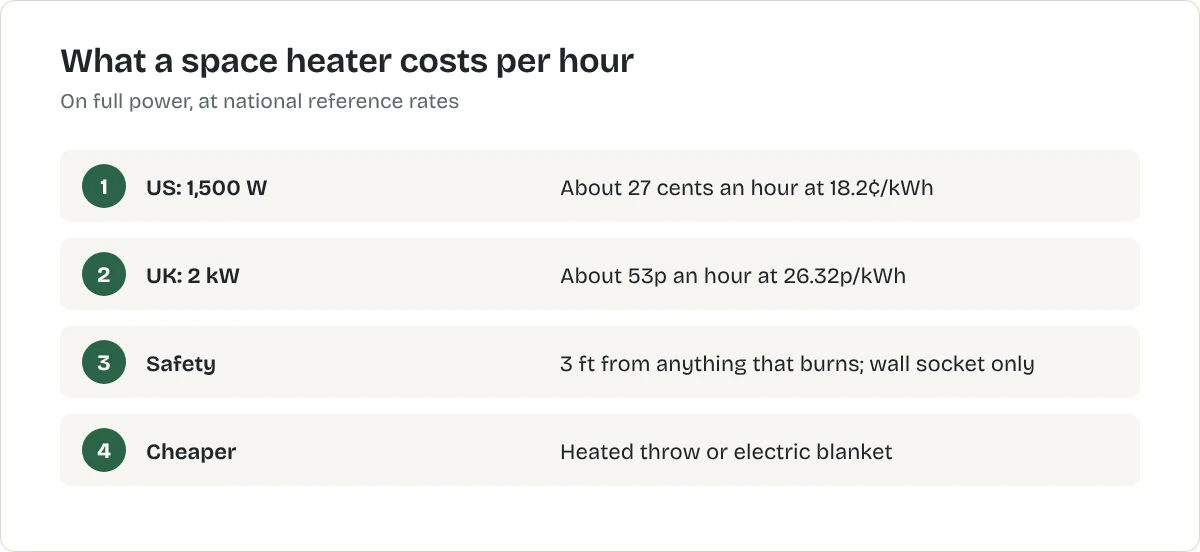
In the United States, a 1,500-watt heater on full power uses 1.5 kWh an hour. At the EIA's 2026 forecast average of 18.2 cents per kWh, that is about 27 cents an hour. Four hours a night for 30 days is about $33 a month. Your state's rate may be very different, so use the rate on your bill.
In the UK, a 2 kW heater on full power uses 2 kWh an hour. At Ofgem's price cap unit rate of 26.32p per kWh for October to December 2026, that is about 53p an hour. Four hours a night for 30 days is about £63 a month. Use the rate on your own bill.
The electricity cost calculator does the sum for any wattage and rate.
Step 3: Allow for the thermostat
A heater with a thermostat cycles on and off once the room is warm, so it may use less than its full rating over an evening. A plug-in energy monitor shows what yours really uses.
Best for finding out what one appliance really uses
Plug-in electricity usage monitor
A meter that sits between the socket and an appliance and shows its consumption. This is a type of product, not one model. The button opens the retailer's results for it, so compare a few before you choose.
What we like
- Measures real use over a day or week, not the label's maximum
- No app or Wi-Fi needed
- Moves from appliance to appliance
What to know
- Buy the version made for your country's sockets and voltage
- Small displays are hard to read behind furniture
- Accurate enough to compare appliances, not to check a bill
United States
United Kingdom
Not listed with our CA retailers yet.
Not listed with our AU retailers yet.
Research-based recommendation: we have not tested this product ourselves. How we evaluate products. Details checked October 2026.
Run it safely
Fire safety advice, as summarised by US PIRG from Consumer Product Safety Commission figures, is consistent:
- Keep heaters at least three feet (about one metre) from anything that can burn: bedding, curtains, sofas and rugs.
- Plug them directly into a wall socket, never an extension lead or power strip.
- Choose a heater with tip-over and overheat shut-off.
- Never leave one running when you leave the room or go to sleep.
Cheaper ways to stay warm
- Heat yourself, not the room. A heated throw or electric blanket costs pennies an hour. See electric blanket vs space heater.
- Stop draughts at doors and windows.
- Close curtains at dusk and open them on sunny days.
- Heat one small room with the door closed, rather than the whole flat.
Common mistakes to avoid
- Running it on full power all evening. Use the thermostat and the lower setting once the room is warm.
- Using it to dry clothes. It is a fire risk.
- Comparing with central heating without checking rates. Gas is often much cheaper per kWh than electricity in the UK.
What to do next
Read your own unit rate from your bill with how to read your electricity bill, then compare the heater with the alternatives in what uses the most electricity at home.
How to work out your own cost
Find the heater's wattage on its label. Divide by 1,000 to get kilowatts, then multiply by your electricity price per kWh. A 2,000 W heater uses 2 kWh an hour, so at the UK price cap rate of 26.32p per kWh it costs about 53p an hour on full power; at the US average of 18.2¢ per kWh, about 36¢ an hour. Thermostats and lower settings mean the heater runs at full power for only part of the time, so real costs are often lower.
Ways to cut the cost
- Heat the person, not the room: a heated throw costs a few pence an hour.
- Heat one small room with the door closed, not an open-plan space.
- Use the thermostat and timer rather than leaving it on full.
- Fix draughts first so the heat stays in.
Frequently asked questions
How much does a 1,500-watt heater cost per hour in the US?
At the EIA's 2026 forecast average of 18.2 cents per kWh, about 27 cents an hour on full power. Your own rate may be higher or lower.
How much does a 2 kW heater cost per hour in the UK?
At the October to December 2026 price cap rate of 26.32p per kWh, about 53p an hour on full power.
Is it cheaper to run a space heater than central heating?
For one small room for a short time, it can be. Heating several rooms with electric heaters is usually expensive. Compare your electricity and gas unit rates.
Sources
Related articles
Energy & Money Saving
Electric Blanket vs Space Heater: Cost Compared
Heating yourself costs a fraction of heating a room. How the running costs of an electric blanket, a heated throw and a space heater compare at US and UK rates.
Energy & Money Saving
What Do Your Appliances Cost to Run?
Any appliance's running cost comes from one short formula and two numbers you already have. Here is the sum, worked examples, and what standby really costs.
Home Comfort
How to Make an Apartment More Comfortable
Most discomfort in an apartment comes from five things: temperature, air, noise, light and clutter. Here is how to fix each, starting with what costs nothing.