How to Read Your Electricity Bill
An electricity bill comes down to a few numbers: what you used, the price of each unit and a fixed daily or monthly charge. Here is where to find them on US and UK bills, and what to check.
In this article
What you need to know first
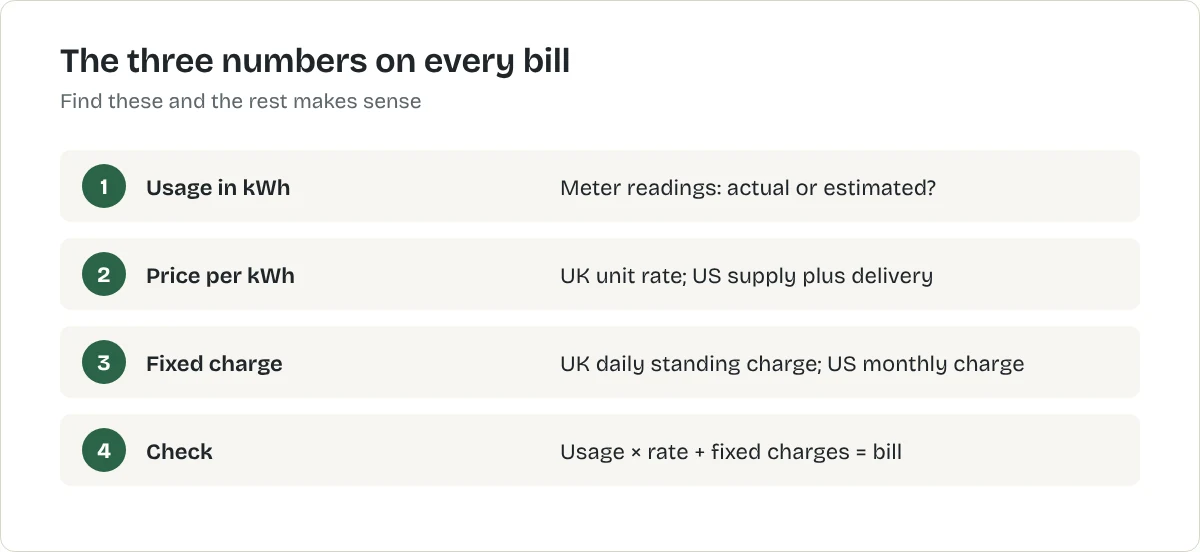
Every electricity bill, in the US or the UK, is built from the same three parts:
- How much you used, in kilowatt-hours (kWh).
- The price of each kWh.
- A fixed charge you pay whatever you use: a daily standing charge in the UK, or a monthly customer or service charge on many US bills.
Find those three and the rest of the bill makes sense.
Step 1: Find your usage
Look for "usage", "consumption" or a line in kWh. A good bill shows the meter readings at the start and end of the period; the difference is what you used.
Check whether each reading is actual (taken from the meter, by you, the supplier or a smart meter) or estimated (A or E on many bills). Estimated readings can be far off. If they are, submit your own reading with a dated photo of the meter.
Step 2: Find your price per kWh
In the United States, your bill may split the price into supply (or generation), the cost of the electricity itself, and delivery (or transmission and distribution), the cost of getting it to you. Add the per-kWh parts together for your real rate. For comparison, the US Energy Information Administration forecasts an average residential price of 18.2 cents per kWh for 2026; state averages vary widely.
In the UK, look for the unit rate in pence per kWh. Under Ofgem's price cap from 1 October to 31 December 2026, the average electricity unit rate for direct debit customers is 26.32p per kWh, and VAT has been removed from domestic electricity for this period. Your region, payment method and tariff change the figure. If you are on a fixed deal, the cap does not apply until the deal ends.
Step 3: Find the fixed charge
In the United States, many bills carry a fixed monthly customer or service charge. It is paid whatever you use, so cutting usage does not reduce it.
In the UK, the standing charge is a fixed daily amount. Ofgem's average for electricity paid by direct debit is 54.83p a day from 1 October to 31 December 2026, which is about £50 over three months before you use a single unit.
Step 4: Check the maths
Usage × unit rate + fixed charges + any taxes = the bill. If it does not add up, or a reading is clearly wrong, contact your supplier with a meter photo. Keep a note of readings each month; it makes mistakes obvious.
Step 5: Compare with last year
Most bills show usage for the same period last year. A big jump without a change in your habits can mean a faulty appliance, a wrong reading or a tariff change.
Common mistakes to avoid
- Ignoring estimated readings. They add up, in either direction.
- Comparing bills by total only. Compare kWh used; prices change.
- Forgetting the fixed charge when working out what an appliance costs. Use the unit rate for that.
What to do next
Use your unit rate to work out what each appliance costs with what do your appliances cost to run? and the electricity cost calculator. Then see what uses the most electricity at home to know where to start cutting.
Estimated or actual?
Check whether the bill uses an actual meter reading or an estimate. Estimates are marked, often with an "E". If yours is estimated, submit a reading, with a dated photo of the meter, so you pay only for what you use. In the UK, a smart meter sends readings automatically, but it is still worth checking the reading on the bill matches the meter now and then.
Check your tariff
Your bill shows your tariff name and when it ends. If you are on a fixed deal that is ending, compare other offers before it rolls onto the default rate.
Frequently asked questions
What is a kWh on my bill?
A kilowatt-hour: 1,000 watts used for one hour. It is the unit your supplier charges for.
What is a standing charge?
In the UK, a fixed daily charge you pay whatever you use. Under Ofgem's price cap from 1 October to 31 December 2026, the average electricity standing charge for direct debit customers is 54.83p a day.
Why does my bill say estimated?
Your supplier did not have a meter reading for that period and guessed. Submit a reading or take a dated photo of the meter so the next bill is accurate.
Sources
Related articles
Energy & Money Saving
How to Reduce Electricity Bills in an Apartment
Where the electricity goes in an apartment, and the changes a renter can make to use less of it, starting with the free ones.
Energy & Money Saving
What Uses the Most Electricity at Home?
Heating and cooling come first in most homes, then water heating, then the fridge and lighting. Here is how to find out what uses the most in yours, US and UK.
Energy & Money Saving
Electric Blanket vs Space Heater: Cost Compared
Heating yourself costs a fraction of heating a room. How the running costs of an electric blanket, a heated throw and a space heater compare at US and UK rates.